By 6days · v1.0 · Updated 7/20/2026
Separate urgent from important, and notice how much of your week serves neither.
Fill this in for your own situation — a private worksheet only you can see.
When to use
Use it when you are busy but not progressing, when a team is permanently reactive, or during a periodic review of where a role's time actually goes. It works well as a recurring habit rather than a one-off, and it is a useful device for a manager and report to look at a workload together without it becoming personal.
When not to use
Avoid it where you have little real autonomy — telling someone to delegate work they cannot delegate is just a way of blaming them for their constraints. It handles individual tasks better than long collaborative efforts, and it has nothing to say about work that is important to someone else and not to you, which is most of what makes a job hard. It also assumes you can tell importance from urgency, which is exactly the skill people struggling with this tend to lack.
Urgency is loud and importance is quiet. Work that matters — the strategy, the fix that prevents next quarter's incident, the conversation with the struggling team member — has no deadline, so it loses every day to whatever is shouting. Weeks pass full of activity and empty of progress, and the diagnosis is always 'no time', when the truth is that the important work never once won a scheduling contest against the merely urgent.
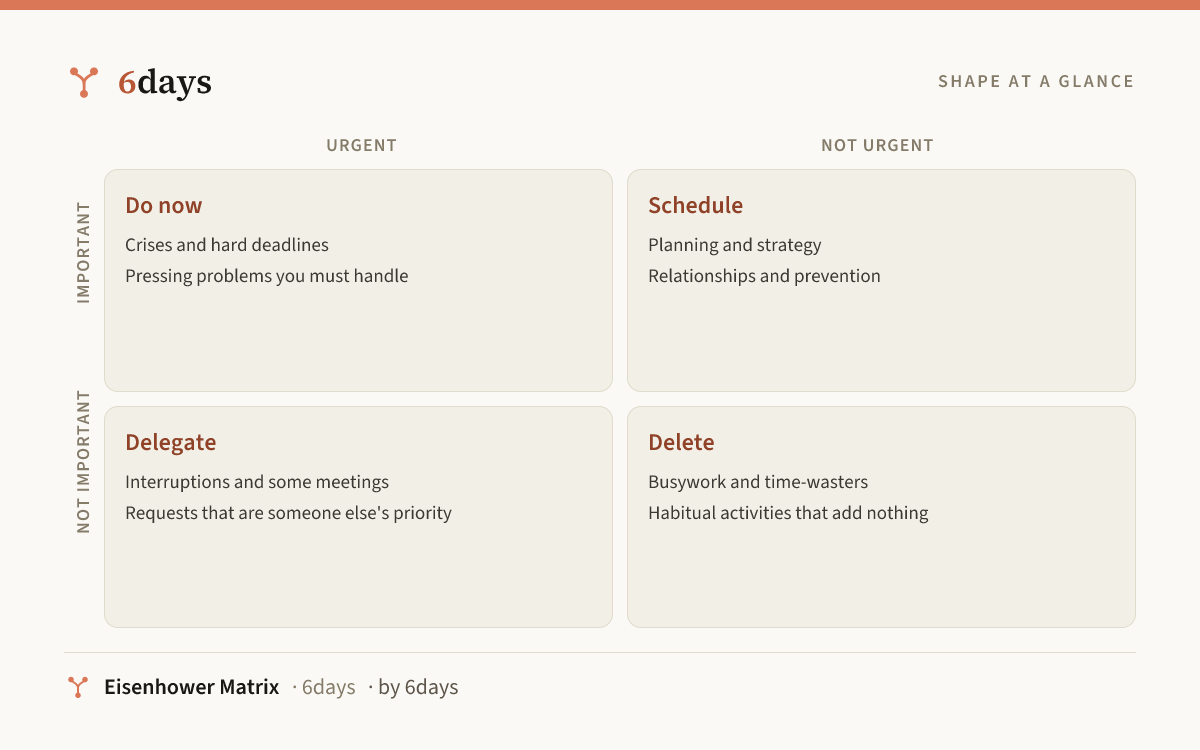
The matrix sorts work on two independent axes: important (contributes to outcomes you care about) and urgent (demands attention now). The four quadrants get different treatment. Important and urgent: do it, but treat its existence as a signal, since most crises are the residue of neglected important work. Important, not urgent: schedule it, because this is where nearly all real progress lives and it will never demand attention on its own. Urgent, not important: delegate it, or resist it — it is usually someone else's priority wearing your calendar. Neither: stop. The insight is that urgent and important are genuinely independent, and most people's calendars silently assume they are the same axis.
Framework by 6days on 6days — https://6days.apexaion.ai/framework/eisenhower-matrix
A two-by-two matrix. The horizontal axis runs from Urgent on the left to Not urgent on the right; the vertical axis runs from Important at the top to Not important at the bottom. Top-left: Do now — Crises and hard deadlines, Pressing problems you must handle. Top-right: Schedule — Planning and strategy, Relationships and prevention. Bottom-left: Delegate — Interruptions and some meetings, Requests that are someone else's priority. Bottom-right: Delete — Busywork and time-wasters, Habitual activities that add nothing.
List the actual demands — tasks, meetings, requests, the recurring things you have never questioned. Work from your real calendar and inbox rather than from memory, which reliably omits the routine items that consume the most hours.
Importance is meaningless in the abstract, so name the outcomes you are accountable for and judge each item against them. Anything that contributes to none of them is not important, however comfortable or familiar it is.
Ask what genuinely happens, and to whom, if this waits a week. Most 'urgent' items have a soft consequence and a loud sender. Rating this independently of importance is the whole mechanism; collapsing the two axes reproduces the problem you came to solve.
Do the important-and-urgent, delegate or decline the urgent-but-not-important, delete the rest — and then actually put the important-not-urgent work in the calendar as a booked commitment. If it stays on a list it will lose again next week, exactly as it lost last week.
Worked example
An engineering manager audits a week. Urgent and important: a production incident, four hours. Urgent, not important: eleven meetings where they were informed rather than needed, nine hours. Important, not urgent: hiring, the architecture decision blocking two teams, and a struggling report's development conversation — zero hours, as every week. Neither: two standing meetings inherited from a reorganisation eighteen months ago that nobody has cancelled. Declining six meetings and booking two protected blocks moves nine hours into the quadrant that was empty. The incident, it later turns out, was caused by the architecture decision that never got made.
The urgent-versus-important distinction is popularly attributed to Dwight D. Eisenhower, who quoted a formulation of it in a 1954 address and credited it to an unnamed university president. It was later developed into a four-quadrant tool by Stephen Covey and others in the time-management literature of the 1980s and 1990s. Eisenhower did not devise the matrix that bears his name.
Related ways to think about this.
Observe, orient, decide, act — and win by cycling faster than the situation changes.
Use when Use it in genuinely competitive, fast-changing situations — an incident, a live negotiation, a competitor's surprise move, a crisis. It suits environments where information is incomplete by nature and waiting for completeness means losing.
Avoid when Avoid it for decisions that are expensive to reverse and slow-moving: a factory site or a pension scheme does not want tempo, it wants analysis. It is widely misread as 'decide fast', which drops the orient step and produces speed without judgement. It also has little to say where there is no adversary and no clock.
Strip a problem back to what must be true, then rebuild — instead of copying what exists.
Use when Use it when an industry's costs or practices have been stable for a long time without obvious justification, when you are entering a field as an outsider and lack the incumbents' assumptions, or when repeated incremental attempts have all failed and the problem may be framed wrongly.
Avoid when Avoid it for routine decisions — it is slow, effortful, and analogy is right most of the time. It is also a common vehicle for arrogance: reasoning from first principles while lacking domain knowledge tends to rediscover why the convention exists, expensively. If experts cannot explain why a practice exists, that is worth investigating; if they can, listen.
Score competing work on reach, impact, confidence and effort so the argument is about evidence.
Use when Use it when you have many comparable candidates competing for one team's capacity, when prioritisation has become political and you need a neutral vocabulary, or when you need to explain to stakeholders why their request did not make the cut without it being personal.
Avoid when Avoid it for work that is not discretionary — security fixes, legal obligations and keeping the service up do not get scored, they get done. It handles strategic bets badly: anything genuinely new scores low on confidence and reach by construction, so a team that follows RICE mechanically will optimise itself into small safe increments forever. It also cannot see dependencies or sequencing.