By 6days · v1.0 · Updated 7/20/2026
Sort what you know about a decision into four buckets so the gaps become obvious.
Fill this in for your own situation — a private worksheet only you can see.
When to use
Use it early, when a group needs to pool what it collectively knows before choosing a direction — entering a market, responding to a competitor, or opening annual planning. It is most valuable when the people in the room hold different pieces of the picture and have never assembled them in one place.
When not to use
Avoid it when you need a decision rather than an inventory: SWOT ranks nothing and will not tell you what to do. It rewards confident assertion, so it degrades badly in rooms with a strong seniority gradient. And it is a snapshot — for anything fast-moving it dates quickly, and a stale SWOT presented as current is worse than none.
A team knows a great deal about its own situation, but the knowledge is scattered across people and half-remembered conversations. When a decision arrives, discussion circles: someone raises a threat, someone counters with a strength, and nobody can tell whether the group has covered the ground or simply argued loudly. What is missing is not intelligence but a shared inventory.
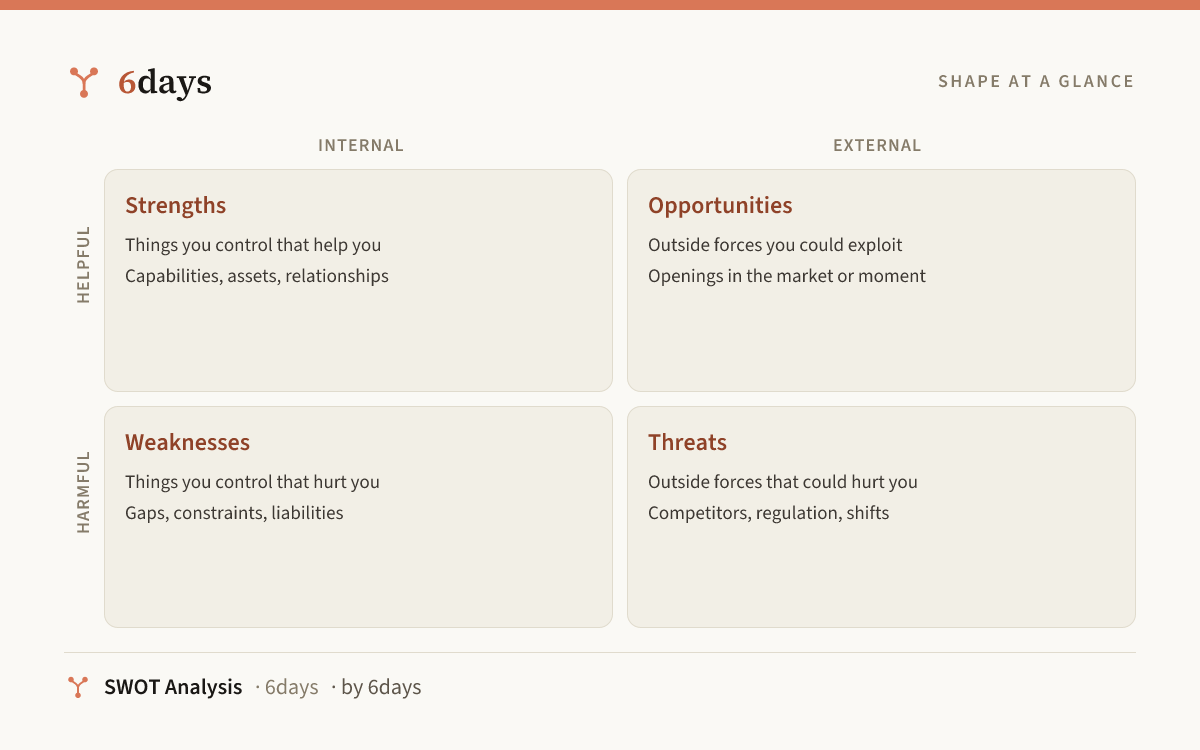
SWOT sorts everything you know into four buckets along two axes: helpful versus harmful, and internal versus external. Strengths and weaknesses are things you control. Opportunities and threats come from outside and will happen whether or not you act. The value is less in the four lists than in what the sorting exposes — an empty quadrant usually means a blind spot rather than an absence, and a strength that maps onto no opportunity is a capability you are not using. Treat it as a structured inventory that sets up a decision, never as the decision itself.
Framework by 6days on 6days — https://6days.apexaion.ai/framework/swot-analysis
A two-by-two matrix. The horizontal axis runs from Internal on the left to External on the right; the vertical axis runs from Helpful at the top to Harmful at the bottom. Top-left: Strengths — Things you control that help you, Capabilities, assets, relationships. Top-right: Opportunities — Outside forces you could exploit, Openings in the market or moment. Bottom-left: Weaknesses — Things you control that hurt you, Gaps, constraints, liabilities. Bottom-right: Threats — Outside forces that could hurt you, Competitors, regulation, shifts.
Name precisely what you are analysing and over what period. 'Our company' is too broad to produce anything useful. 'Our position in the mid-market segment over the next eighteen months' gives every later item a test for relevance. Most weak SWOTs fail here, not later.
List strengths and weaknesses — the things within your control. Push for specifics with evidence attached. 'Strong brand' is a comfortable phrase that survives because nobody checks it; 'we win 60% of head-to-head deals against our closest competitor' can be argued with, which is what makes it useful.
List opportunities and threats — forces that exist independently of you: regulation, competitor moves, shifts in what customers expect, technology, cost of capital. The discipline is to record them as they are rather than as you would like them to be.
A quadrant with nothing in it is a signal about your attention, not about reality — teams under pressure routinely produce no weaknesses. A quadrant with thirty entries means you have not prioritised. Both are findings worth more than the lists themselves.
Pair items deliberately: which strength lets you take which opportunity? Which weakness leaves you exposed to which threat? This is where a SWOT stops being a list and starts producing candidate actions. Carry only the pairs into the decision, not the raw inventory.
Worked example
A regional logistics firm considers opening a second depot. Strengths: dense driver network, 20-year customer relationships. Weaknesses: ageing fleet, no software team. Opportunities: a competitor has just exited the region. Threats: fuel costs, an incoming emissions rule. Crossing the quadrants does the real work — the driver network against the competitor's exit argues for moving now, while the ageing fleet against the emissions rule says the depot must not be funded by deferring fleet replacement. The four lists alone would have said neither.
SWOT emerged from corporate planning research in the United States around the 1960s, and is often associated with work done at Stanford Research Institute in that period. Attribution to any single author is disputed, and the framework has been reshaped by decades of practice since. It is best treated as a common inheritance of business planning rather than anyone's proprietary method.
Related ways to think about this.
Explain why an industry is profitable — or isn't — before you commit to competing in it.
Use when Use it before entering an industry, before a major capital commitment, or when strong execution is somehow producing weak margins and you need to know whether the problem is you or the structure you are operating inside.
Avoid when Avoid it for short-term or tactical calls — it describes structure, which moves over years. It fits industries with recognisable boundaries better than fluid ecosystems and platforms, where roles blur and today's supplier is next year's competitor. It also says nothing about your own capabilities, and it is a snapshot of a structure that will keep moving after you present it.
Scan the six external forces that will shape your market whether or not you act.
Use when Use it when entering an unfamiliar market or geography, when setting strategy over a multi-year horizon, or when a business is heavily exposed to regulation, commodity prices, or public sentiment. It pairs naturally with a competitive analysis, which handles the forces PESTEL deliberately ignores.
Avoid when Avoid it for operational or short-horizon decisions, where macro forces move too slowly to matter and the exercise becomes theatre. It also has no opinion about your competitors, your customers, or your own capabilities — mistaking a completed PESTEL for a strategy is the standard failure.
Compete somewhere else: redraw the offer so the current rivalry stops being the question.
Use when Use it in a commoditised market where competitors are near-indistinguishable and margins are eroding, or when a large population plainly declines to buy from anyone in the category and you want to know why.
Avoid when Avoid it in a young market where the rules are not yet settled — there is no convergence to escape. Be wary of it as a rationalisation: 'we compete differently' is the most comfortable thing a losing company can tell itself, and the framework supplies attractive language for it. The literature also selects heavily on winners, so the base rate for this working is far lower than the case studies imply.